
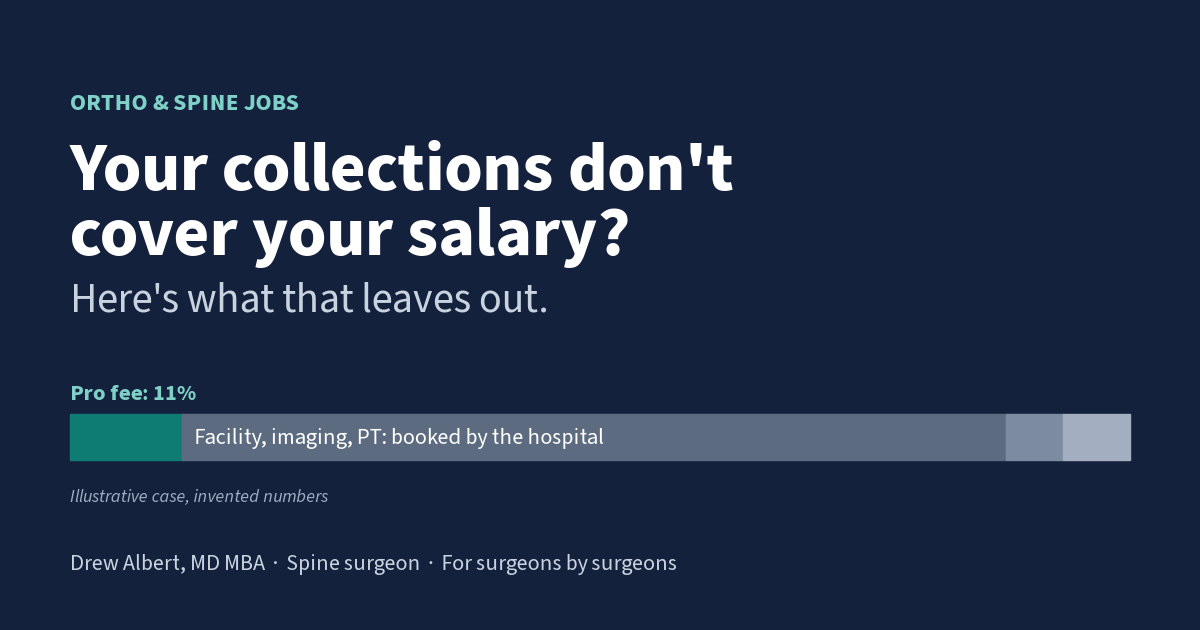
By Drew Albert, MD MBA, spine surgeon | Ortho & Spine Jobs: For surgeons by surgeons
“Employed surgeons get told ‘your collections don’t cover your salary.’ Then why does the hospital keep recruiting you? Your cases fill their OR. That facility fee just never shows up on your line.”
Stay employed long enough and you’ll hear it in a comp meeting. Someone puts your professional collections next to your salary and overhead. The gap reads like a debt you owe.
The math on that sheet is usually right. The problem is what the sheet leaves off. Below: what’s missing, why hospitals keep recruiting surgeons anyway, and what I’d say at renewal.
Professional fee vs. facility fee: one case, two bills
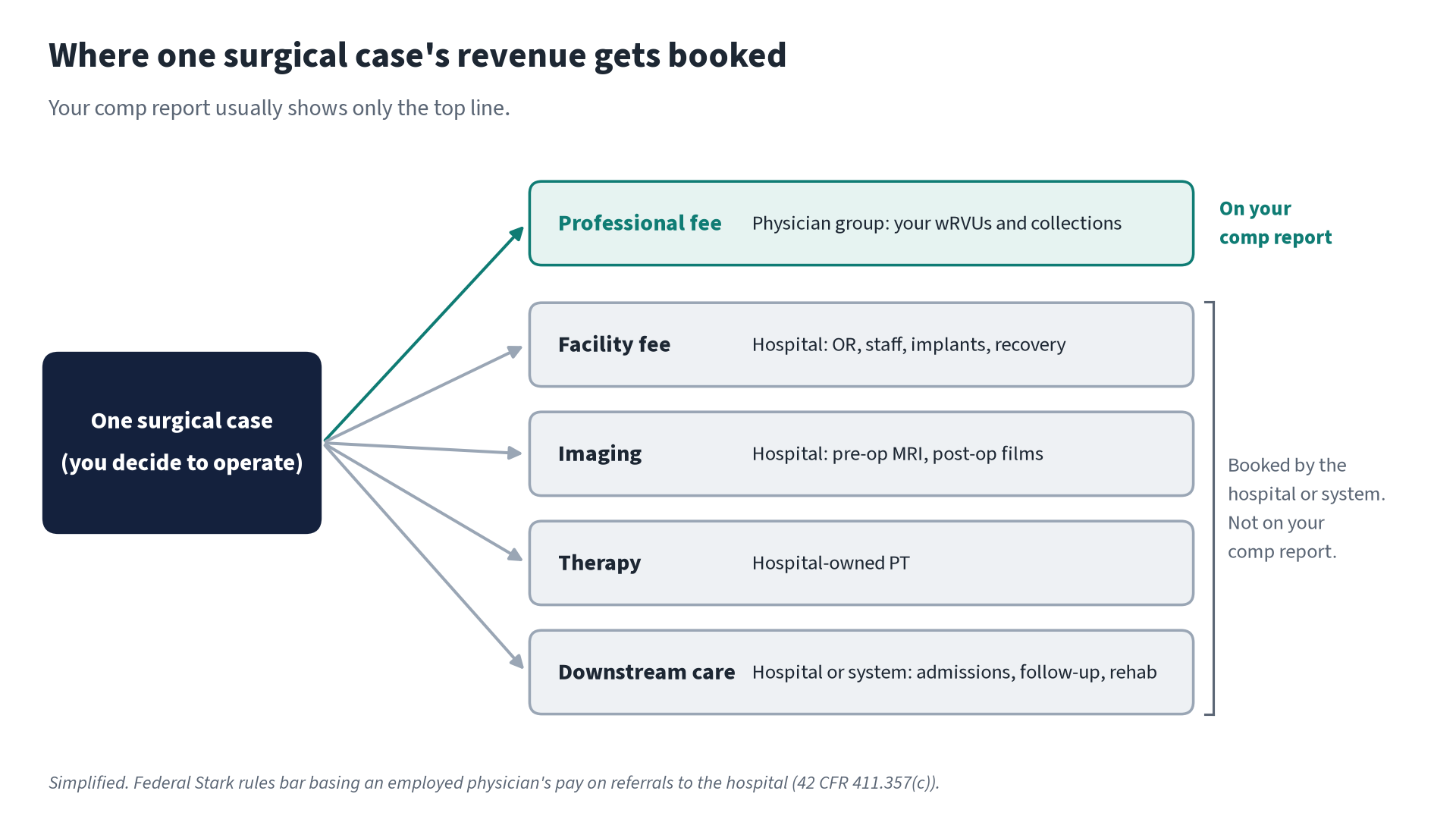
Every case you book produces at least two bills.
- The professional fee pays for your work. Medicare pays it under the Physician Fee Schedule: RVUs times a conversion factor, adjusted for geography. (New to RVUs? Start with our explainer, What is an RVU?) This is the “collections” number on your report.
- The facility fee pays the hospital or surgery center for the OR, staff, supplies, implants, recovery, and the stay. Medicare pays it through separate systems: the Inpatient PPS (MS-DRGs) for admissions, the Hospital Outpatient PPS (APCs) for outpatient cases, and the ASC payment system for surgery centers.
The facility side carries real costs. Staff, implants, and the building aren’t free, so the facility fee isn’t profit. But it is revenue, and it exists because you decided to operate.
Then there’s the work around the case: pre-op MRI, labs, PT, braces, follow-up films, and sometimes a rehab stay or a readmission. Almost none of it lands on your line.
An illustrative case (invented numbers)
These numbers are made up to show the structure. They are not real payer rates, contract terms, or any institution’s data. Real figures vary widely by payer, region, setting, and procedure.
One hypothetical, commercially insured, single-level outpatient spine case in a hospital outpatient department:
| Revenue stream | Who books it | Illustrative amount | Share |
|---|---|---|---|
| Surgeon professional fee (collected) | Physician group (your line) | $3,000 | 10.6% |
| Facility fee (OR, recovery, supplies, implants) | Hospital | $22,000 | 77.7% |
| Pre-op MRI and post-op imaging | Hospital | $1,500 | 5.3% |
| Post-op PT course | Hospital-owned PT | $1,800 | 6.4% |
| Total case-related revenue | $28,300 | 100% |
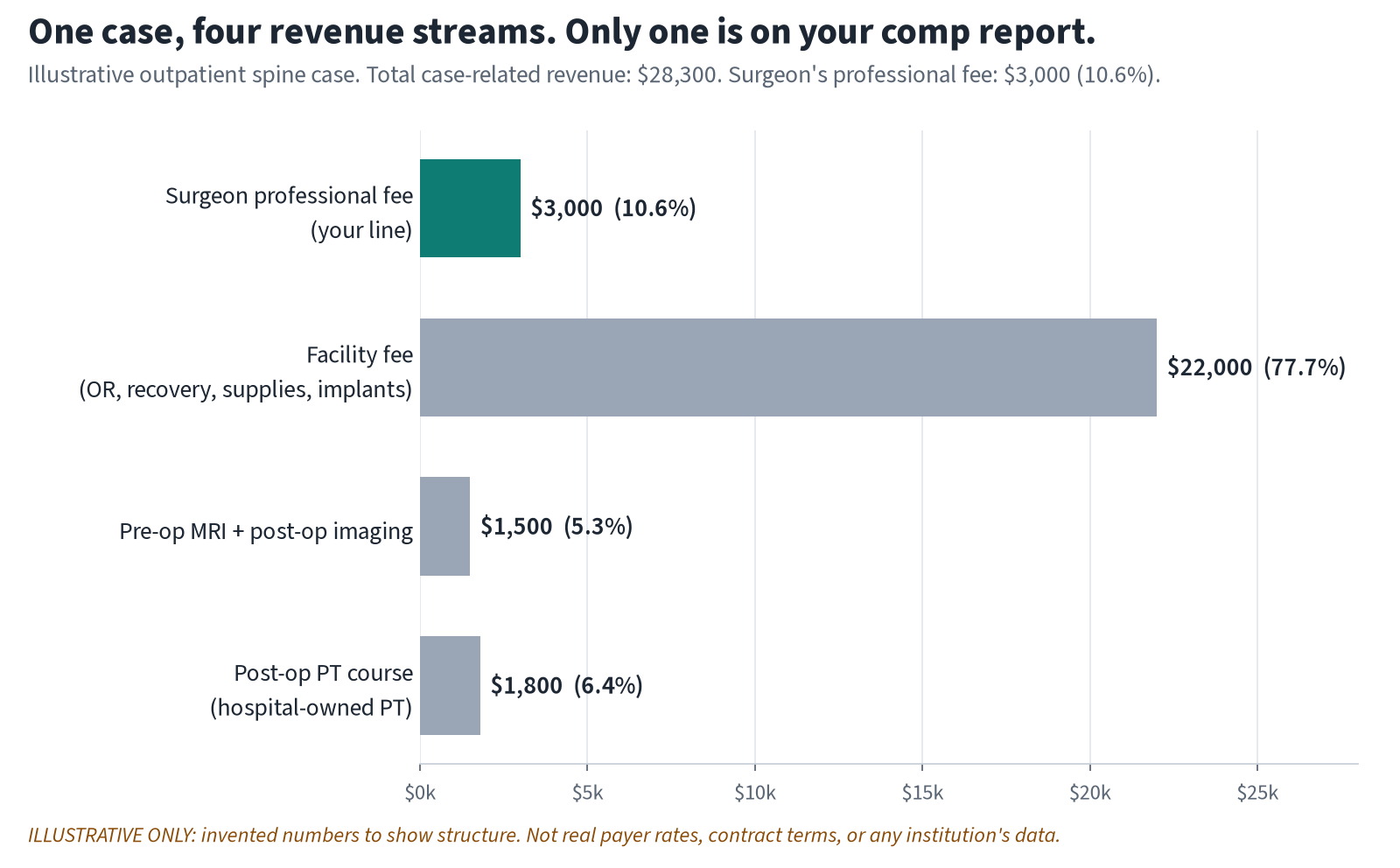
The surgeon’s line gets $3,000 of $28,300, about 11%. Swap in your own numbers and the pattern holds. A report that counts only the pro fee measures a small slice of what your cases bring in.
What hospital CFOs reported
Merritt Hawkins asked hospital CFOs this directly. In its 2019 Physician Inpatient/Outpatient Revenue Survey, orthopedic surgeons generated an average of $3,286,764 a year in net inpatient and outpatient revenue for their affiliated hospitals. That counts admissions, procedures, tests, and treatments ordered. The same report set that against an average $533,000 starting salary offered to recruit orthopedic surgeons, taken from the firm’s 2018 recruiting-incentive data. That’s roughly six to one.
Read it with the caveats the report itself gives. It’s a small sample: 62 responses representing 93 hospitals, weighted toward smaller hospitals. It measures revenue, not profit. And it’s from 2019. I couldn’t find a newer edition. Pay has moved since then: Doximity’s 2026 Physician Compensation Report puts average orthopaedic surgery compensation at $696,852, based on self-reported 2025 data.
The point stands. Hospitals book a lot of money around your cases.
Why hospitals keep recruiting you
If surgeons really lost money, systems wouldn’t compete to hire them. They do it for a few concrete reasons.
Fixed costs. ORs, anesthesia coverage, sterile processing, and beds cost money whether you operate or not. Finance teams judge a service line by its contribution margin: revenue minus direct costs. Every added case spreads that fixed cost thinner.
Downstream revenue. Your clinic feeds imaging, PT, pain management, admissions, and follow-up. That is exactly what the Merritt Hawkins survey counted.
Service line strategy. Ortho and spine anchor trauma call, ED coverage, and transfers. Lose a spine surgeon and you can lose the call panel and the transfers that come with it.
Why your report shows only the pro fee
Many employed contracts pay on wRVUs, not collections. That’s partly by design.
Under the federal physician self-referral law (Stark), the employment exception requires pay that is consistent with fair market value and not determined in any manner that takes into account the volume or value of your referrals. A productivity bonus based on services you personally perform is allowed. The hospital’s side of your case (the facility fee, imaging, therapy) is a referral under Stark. So your employer can’t pay you a share of it, and it never shows up on your line.
That cuts both ways. If the facility fee can’t count toward your pay, a pro-fee-only “loss” shouldn’t be used against you either. Stark’s own definition of “commercially reasonable” says an arrangement can be commercially reasonable even if it doesn’t make a profit for one of the parties. Losing money on professional fees is a normal, legal feature of employed models.
The fair question is whether your pay is FMV for the work you do. Salary surveys are where that starts, not where it ends. As MGMA’s explainer on FMV under Stark notes, CMS has said FMV may not always align with published survey data, and a sought-after surgeon with a specific skill set may warrant more. CMS’s physician self-referral overview covers the basics.
How to handle it at renewal
Don’t try to win an argument about facility fees. The law keeps them out of your pay, so arguing about them goes nowhere. Move the conversation to what does set your pay: your production, FMV, and the support you need to do the work.
Know your numbers
- Get your monthly wRVU report by CPT code, plus collections and payer mix, for the last 12 to 24 months.
- Know your conversion factor ($ per wRVU) and any tier thresholds. Check which RVU year the contract uses. Some contracts freeze an older year’s values.
- Benchmark it. Know where your wRVUs, total comp, and comp per wRVU fall by percentile for your specialty and region. MGMA DataDive Provider Compensation is the standard (it’s a paid product). For a surgeon-reported cross-check, use our orthopedic and spine compensation map. If you produce at the 75th percentile and get paid at the 40th, that gap is your case.
- Audit your credit. Look for missed charges, unbilled assists, missing modifiers, and inpatient consults nobody credited to you.
Know the system’s numbers
- Ask for service line contribution margin. Many systems won’t break it out by surgeon, and legal may push back. Service line level is an easier ask.
- Keep a rough log of the imaging, PT, and admissions your patients generate. Use it to understand your value. Keep it out of any pay or perks request. Tying anything of value to referral volume is a Stark and Anti-Kickback problem.
Negotiate the whole package, not just base
- Call: stipend per shift, frequency, and what counts as unassigned ED call.
- APP support: a dedicated PA or NP for clinic and rounding protects your OR time and your wRVUs.
- Block time: guaranteed blocks, first starts, and release rules.
- Clinic staff: MAs, schedulers, and prior-auth help.
- Credit rules: how split/shared and supervised APP visits are credited, and how teaching or admin time is paid. Have your attorney confirm what’s allowed.
Scripts
When you hear “your collections don’t cover your salary”:
“Right, the pro fee alone doesn’t cover it. That’s true for most employed surgeons, and it’s why we’re paid on wRVUs. Can we look at my wRVUs against MGMA for spine in our region?”
When you ask for data:
“Before renewal, can you send my last 24 months of wRVUs by CPT, plus collections and payer mix? If you can share service line contribution margin, I’d like that too. I want us working from the same numbers.”
At renewal:
“I’m at about the [X]th percentile for wRVUs and the [Y]th for comp per wRVU. I’d like the conversion factor moved to match my production, with an FMV opinion to support it.”
On support and call:
“If you want more volume, the bottleneck is clinic. A dedicated PA and one more block day gets you more cases without more call. I’d also like to revisit the call stipend. I’m taking [N] nights a month now.”
Bring the numbers. Skip the facility-fee debate.
When to walk
Some problems don’t get fixed at the table. Watch for:
- “You’re losing us money” used to justify a pay cut while your wRVUs are strong.
- Refusal to share your own wRVU and collections data, or reports that change without explanation.
- Comp per wRVU stuck well below your production percentile across more than one renewal.
- Unilateral mid-contract changes to the conversion factor, RVU year, or tiers.
- More call with no more pay, or APP and block support shrinking as your volume grows.
- Broad non-competes and tail costs that make leaving expensive by design.
If several of these sound familiar, start looking quietly, well before your notice window. You can browse current orthopedic and spine openings without telling anyone.
FAQ
Why don’t my collections cover my salary as an employed surgeon?
Your collections count only the professional fee. The facility fee, imaging, therapy, and admissions tied to your cases are booked by the hospital. Federal Stark rules keep that revenue out of your pay, so it never appears on your report.
Can a hospital pay me a share of the facility fee?
No. Under the Stark employment exception, your pay must be fair market value and can’t take into account the volume or value of your referrals to the hospital. The hospital’s side of your case counts as a referral. A productivity bonus for work you personally perform, such as wRVUs, is allowed.
Is it legal for a hospital to lose money on my professional fees?
Yes. Stark’s definition of “commercially reasonable” says an arrangement can be commercially reasonable even if it doesn’t make a profit for one of the parties. The question that matters is whether your pay is fair market value for your work.
How much revenue does an orthopedic surgeon generate for a hospital?
In Merritt Hawkins’ 2019 survey of hospital CFOs, orthopedic surgeons generated an average of $3,286,764 a year in net inpatient and outpatient revenue for their affiliated hospitals. The sample was small, and revenue isn’t profit, but it shows the scale.
What should I benchmark before a wRVU contract negotiation?
Your annual wRVUs, total compensation, and compensation per wRVU, each by percentile for your specialty and region. Also check your conversion factor, tier thresholds, and which RVU year the contract uses.
The bottom line
“Your collections don’t cover your salary” can be true and still miss most of the picture. Learn the two-bill structure. Know your wRVU and FMV numbers cold. Negotiate on production and support, not on facility fees the law won’t let either side count.
Ortho & Spine Jobs is built for surgeons by surgeons, and it costs surgeons nothing. Browse orthopedic and spine jobs, or tell us what you want in your next role. Your notes stay private.
This article is general education, not legal, tax, or financial advice. Compensation arrangements involve federal and state law, including Stark and the Anti-Kickback Statute. Have a qualified healthcare attorney review any contract before you sign. Survey figures are averages from the named sources and may not reflect your market. The case example uses invented numbers.